

7 Factors to Consider Before Buying an Asphalt Mixing Plant
Construction of road works needs high-quality asphalt, proper production timing, and equipment that is able to operate under difficult conditions. An appropriate choice of an Asphalt Mixing Plant will help to organize project time frames, keep expenses low, and maintain a certain quality of asphalt mixture. But due to the variety of plants, capacities, and specifications, the choice of the equipment becomes a complex task.
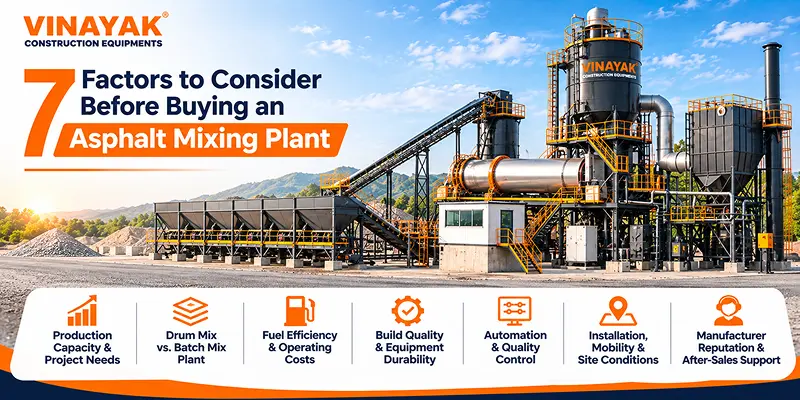
To buy an appropriate asphalt mixing plant one needs to take into account his project demands, site conditions, production expenses, and also services of the manufacturing company. Here are 7 tips to choose a good plant.
7 Factors to Consider Before Buying an Asphalt Mixing Plant
- 1. Production Capacity and Project Needs
At first, calculate the amount of asphalt you will use for your construction project. The capacity of production is given in tons per hour (TPH) and must match your load and deadline.
Inadequate capacity can result in delays in road building; excessive capacity is an extra cost for operation. Consider your present projects and plans before making your choice of capacity. - 2. Choose Between Drum Mix and Batch Mix Plants
It would be helpful if you had some idea of the difference between drum mix and batch mix plants.
The drum mix plant is an asphalt mixing plant that mixes asphalt continuously; hence, it is suitable for construction work where there is a need for constant production of asphalt. The batch mix plant is capable of producing asphalt in batches, and the proportion of the aggregate, bitumen and the fillers can be controlled by the operator.
Consider the nature of the road construction work you do when choosing a plant type. - 3. Fuel Efficiency and Operating Costs
Fuel consumption directly influences the expenses for producing asphalt. To dry the aggregates and keep the temperature of the mixing process constant, additional energy is needed, which is why the heating systems of the plant should be carefully evaluated.
Inquire from the manufacturer about the predicted fuel usage for certain operating conditions. In addition to this, think about the use of electricity, the need to heat bitumen, maintenance issues, and spare parts.
Comparing the total operating cost over the plant's expected service life can give you a clearer picture of its long-term value. - 4. Build Quality and Equipment Durability
Road construction equipment tends to be used in dusty and harsh conditions during production. The quality of manufacturing and assembling of its components could have some impact on the performance and maintenance rate.
Inspect the construction of the dryer drum, mixing unit, conveyors, feeders of aggregates and other important components. Consider asking questions about materials' quality, their warranty and estimated life expectancy.
A well-built plant can help reduce unexpected breakdowns and support more consistent production during busy project periods. - 5. Automation and Quality Control
Modern control systems help operators manage production more accurately. Depending on the plant configuration, automation can support aggregate feeding, temperature monitoring, bitumen dosing, and other production functions.
Prior to purchasing an asphalt mixing plant, consider how convenient it is for operators to monitor and manipulate the process. Find out if the automation system keeps track of the production process, provides troubleshooting options, and can be adjusted depending on mix requirements.
The degree of automation should be chosen based on production requirements, number of operators, and technological capacity. Select a system that helps to manage the process but does not complicate the work process. - 6. Installation, Mobility, and Site Conditions
Your project locations will influence whether a stationary or mobile plant is more practical. A stationary unit may suit contractors with long-term production requirements at a fixed location. A mobile plant can be useful when projects are spread across different sites and equipment relocation is necessary.
Assess the available installation space, ground conditions, access roads, transport arrangements, and local environmental requirements. You should also confirm the foundation, utility, and commissioning requirements with the manufacturer before finalising the purchase. - 7. Manufacturer Reputation and After-Sales Support
After-sales service plays a crucial role in improving the performance of your equipment over time. Any delay in getting technical help or even not having spare parts available will disrupt your manufacturing processes and schedule.
Research on the experience of the manufacturer, range of products, quality assurance, and services. Inquire about installation support, training of operators, warranty period, spares, and technical support response time.
Vinayak Construction Equipments, based in Ahmedabad, India, manufactures road construction equipment, including asphalt drum mix and batch mix plants. Review the available models and discuss your production requirements with the team before selecting a suitable configuration.
Conclusion
Acquisition of the suitable asphalt mixing plant depends on having good information about the production capacity, type of plant, fuel consumption, construction, automation, working site, and after sales service of the particular equipment. Comparing these parameters will assist in making a wise selection.
Looking for suitable asphalt plant options for your road construction projects? Contact Vinayak Construction Equipments to discuss your requirements, explore available plant models, and identify a solution suited to your operational needs. Visit vinayakequipments.com to learn more.


.png)