
Concrete Mixing Plant: Essential Features Every Buyer Should Know
There should be constant supply of high quality concrete to guarantee that the construction schedule is followed without any problems. This may be irrespective of the nature of construction such as a road, bridge, building or industrial facilities since the construction company will need machinery that can supply high quality concrete without any downtime.
A Concrete Mixing Plant mixes important ingredients such as cement, aggregates, water, and additives in the desired proportions to create concrete for different purposes. The size of the plant, mixing operation, automation, installation, and maintenance may vary according to the type of plant. The knowledge of these aspects helps the buyers in selecting the suitable plant according to their requirements and budget.
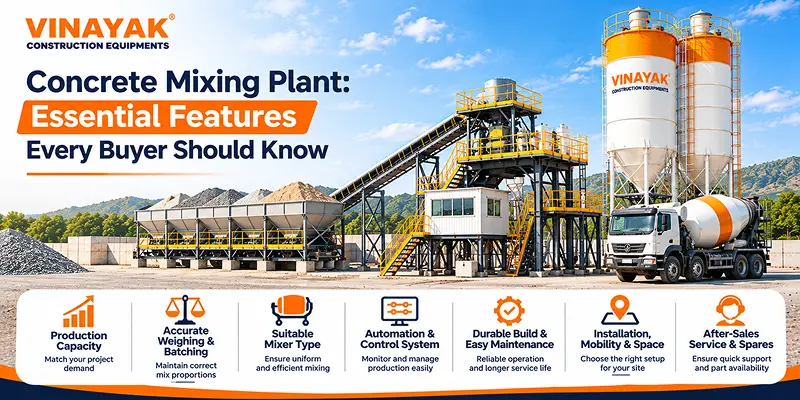
7 Essential Features to Look for in a Concrete Mixing Plant
- 1. Production Capacity That Matches Project Demand
The manufacturing capacity is one of the first things that one should take into account while buying a plant. The lack of manufacturing capacity can result in a delay in delivering concrete, whereas too much manufacturing capacity can affect your budget.
Calculate your project's needs in concrete per hour, load, and maximum production before choosing the right type of plant. If you buy a plant for supplying ready-mix concrete to several projects, you will have different needs than a contractor dealing with only one infrastructure project.
Vinayak Construction Equipments offers concrete batching plant configurations with stated production capacities ranging from 45 to 75 cubic metres per hour on its standard product page. Buyers should confirm the available model specifications and expected site output before making a decision. - 2. Accurate Weighing and Batching Systems
The quality of the concrete is greatly dependent upon the ratio of the concrete ingredients. Any miscalculations in terms of cement, aggregates, water or other additives can affect the quality of the mixture.
Try to find the plant that has an independent weighing system with load cells that are working properly. Batch controllers will enable operators to make measurements based on the chosen mix design.
A well-designed concrete mixing plant should also allow convenient calibration and routine inspection of weighing equipment. This helps maintain consistent batches throughout the production cycle. - 3. Suitable Mixer Type and Mixing Performance
Mixing is an essential function that defines the quality of blending of the materials. Twin shaft and planetary mixers are typical examples of mixers, but the selection depends on the concrete mixture, quantity, and use.
Twin shaft mixers are used for high-volume production of concrete mix, while planetary mixers could be used for applications where controlled mixing action is required. Buyers should take into consideration mixing time, discharge, durability, and applications recommended by the manufacturer.
The selected mixer should handle the required mix consistently without creating unnecessary delays between batches. - 4. Automation and Control Systems
The technology enables operators to control the batching process, observe production, and ensure proper proportions of materials. An operator can have an easy time managing all the tasks when he uses a PLC control panel with a friendly HMI interface.
There are those that provide data recording during production. This is meant to make it easy for the operators to check what happened during the batching process and where the problems arose.
For projects with frequent production cycles, automated controls can improve workflow and help maintain consistent operating standards. - 5. Durable Construction and Easy Maintenance
Many construction equipment works in a tough environment where there is dust and heavy loading in production. This means that there will be much stress on the mechanical parts. Therefore, a strong construction, tough mixer liners, reliable electric, and pneumatic parts may minimize maintenance needs.
Another thing that buyers should take into account is accessibility to the components of the mixer, the places for lubrication, inspection, and replacement of spare parts.
Vinayak Construction Equipments highlights modular designs, quality components, and after-sales support across its concrete batching plant range. These are useful factors to evaluate when comparing equipment suppliers. - 6. Installation, Mobility, and Space Requirements
Installation influences the cost of the project as well as the time it will take for production to begin. Stationary plants are ideal for permanent production, whereas mobile plants could be an option for contractors operating from various locations.
Check the available installation area, foundation requirements, transportation arrangements, power supply, and access for material delivery vehicles. A modular configuration may simplify assembly and dismantling, depending on the selected model.
Vinayak's mobile concrete batching plant range includes compact configurations designed to reduce installation space and transportation requirements. Buyers should review the specific model's mobility options and site preparation needs before ordering. - 7. After-Sales Service and Spare Parts Availability
Performance of equipment for several years would also rely to some extent on the support provided after installation. Any delay in getting replacement parts or technical help could lead to disruption in production.
Before making your decision to buy, inquire regarding the warranty, commissioning, training, spare parts provision, and other service arrangements. You may want to find out if it is possible to source the more commonly needed parts from local suppliers or the company's distribution network.
Reliable support makes equipment ownership easier to manage and helps businesses plan maintenance more effectively.
Conclusion
Plant selection involves proper evaluation of the production capacity, batching accuracy, mixing system, automation, durability, and installation facilities, among others. The comparison of the above parameters with the project requirements will enable one to make a sound investment and ensure proper, consistent production of concrete. Vinayak Construction Equipments provides concrete batch plants and mobile batch plants.
Please visit Vinayak Construction Equipments or contact their team for more information regarding your project requirements.


.png)