
How to Choose the Best Ready Mix Concrete Plant for Your Business
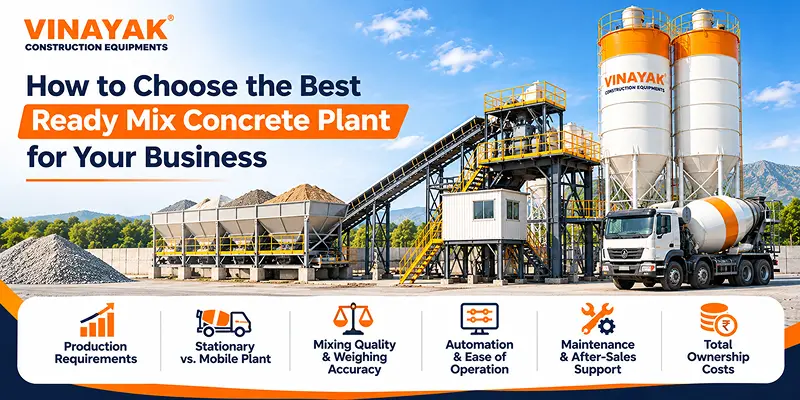
The need for high-quality, consistent concrete is evolving in residential construction, commercial buildings, highways, and in infrastructure projects. Having the right production equipment can mean the difference between a successful and unsuccessful day for the contractor as well as the concrete supplier, in terms of operating costs and project time.
While choosing a Ready Mix Concrete Plant, one should consider several factors including production capacity, location, automation, maintenance, and even the business needs. With proper investment, any company would be able to handle their concrete needs without any problems regarding the quality of the projects.
How to Choose the Right Ready Mix Concrete Plant
- 1. Assess Your Production Requirements
First, make an estimate of the amount of concrete that your business needs to make each hour and day. Requirements will vary between a small contractor working on local projects and a concrete supplier supplying concrete to several construction sites.
When choosing a plant, take into account the amount of work you are already doing, the growth of your business, and the maximum production you anticipate. Too small a system can result in delays during peak times and too large a plant can result in higher startup costs and operating costs.
Vinayak Construction Equipments equips businesses with stationary concrete batching plants of 45m³/h, 60m³/h, and 75m³/h to help them assess their options based on their production requirements. - 2. Choose Between Stationary and Mobile Plants
The type of equipment you choose should be determined by the project locations.
A stationary plant is good for businesses that require concrete production for a long duration and at a fixed location. It can be used for regular production for ready-mix suppliers, commercial construction and large infrastructure projects.
If work is being done in a variety of places, a mobile plant is helpful. The design of this transport vehicle and its ease of installation will assist contractors to move operations as projects evolve.
Consider transportation needs, available installation area, site preparation needs, and the time that each project will require before deciding. - 3. Inspect Mixing Quality and Weighing Accuracy
There must be the right proportions of cement, aggregates, water, and additives when making good concrete. The workability, strength, and uniformity of the concrete will be influenced by the batching.
Try to find a plant equipped with precise electronic weighers and proper mixing arrangement. The particular mix design can be achieved through automated control system, which will help reduce errors in manual operation.
The mixer should also be the same type required in the production process and the type of concrete you typically produce. Before purchase, inquire from the manufacturer about the options for the mixers, batching arrangements, and control features. - 4. Assess Automation and Ease of Operation
Automated procedures may be used to simplify daily manufacturing, including the weight measurement of materials, batches, and their mixing. A good control system will allow the operator to observe the procedure and maintain the production standard.
When choosing equipment, remember that the control panel should be easy to use, there should be operating data, and the equipment should fit your production requirements. The training of employees should also be considered.
A well set-up ready mix concrete plant can help minimize unnecessary operating mistakes and the coordination of activities between the batching, loading and concrete dispatch functions. - 5. Consider Maintenance and After-Sales Support
Concrete delivery delays and construction delays are caused by equipment downtime. Research the availability of spare parts, maintenance needs, service response time and technical assistance before buying.
Inquire about the quality and availability of components of the plant. To better control disruptions and make regular checks and maintenance easier, you can have equipment that is designed for practical maintenance.
When it comes time to getting assistance from the manufacturer for installation instructions, replacement parts or operational help, it can make a difference to select a manufacturer that is experienced and has reliable after sales support. - 6. Compare the Total Cost of Ownership
The price at which the plant is bought is just one aspect of the investment. When comparing options you should take installation, civil work, power use, labour, maintenance, spare parts and other recurring costs into account.
A cheaper plant may not be the most cost-effective choice if it is costly to repair or if you are not achieving the production volumes that you need. Get a detailed quote and specifications, components included, warranties and service offered.
The best ready mix concrete plant should be within budget and agreeable to production and the growth of your business.
Why Consider Vinayak Construction Equipments?
Vinayak Construction Equipments offers concrete batching solutions to meet various construction needs. It ranges from stationary plants with multiple production capacities to mobile batching solutions for projects that require a higher degree of flexibility. The company also states that automated controls, quality parts and after-sales service are among its product offerings.
Talking with the manufacturer about your project requirements can help you determine if there is a configuration that will fit your operations.
Conclusion
The choice of concrete production equipment depends on various factors such as output, mixing accuracy, automation, mobility, maintenance, and total ownership costs. To evaluate these before investing, you can decide on a plant that will suit your existing demands and future plans. To discuss your production requirement, give a call to Vinayak Construction Equipments and find out the best and appropriate solution for your business in regard to concrete batching system.


.png)